From DD-WRT to a rack that stays out of my way.
I have always liked taking hardware apart. At one point I liked it enough to film it, so I ran a YouTube channel: server builds, firewall appliances, IP telephones, whatever networking gear happened to be on the bench that month.
My home network grew out of that habit. It started where most people's start, with a Linksys wireless access point, except mine was running DD-WRT within about a week of coming out of the box. From there I moved to ClearOS, an open source firewall distribution, and then to pfSense on secondhand hardware I picked up cheap. Eventually pfSense graduated onto a 1U server I assembled out of spare parts, because I had spare parts and I had a rack, and that seemed like the obvious thing to do with both.
That setup worked, and it worked because I was in it constantly. Upgrades were research projects. An outage could take a Saturday. The network was only ever as good as the last free weekend I had spent thinking about it, which was fine for a long time and then quietly stopped being fine: more devices, more people depending on it, less of my time available for a part of the stack I had already solved five times over.
So I bought a Dream Machine.
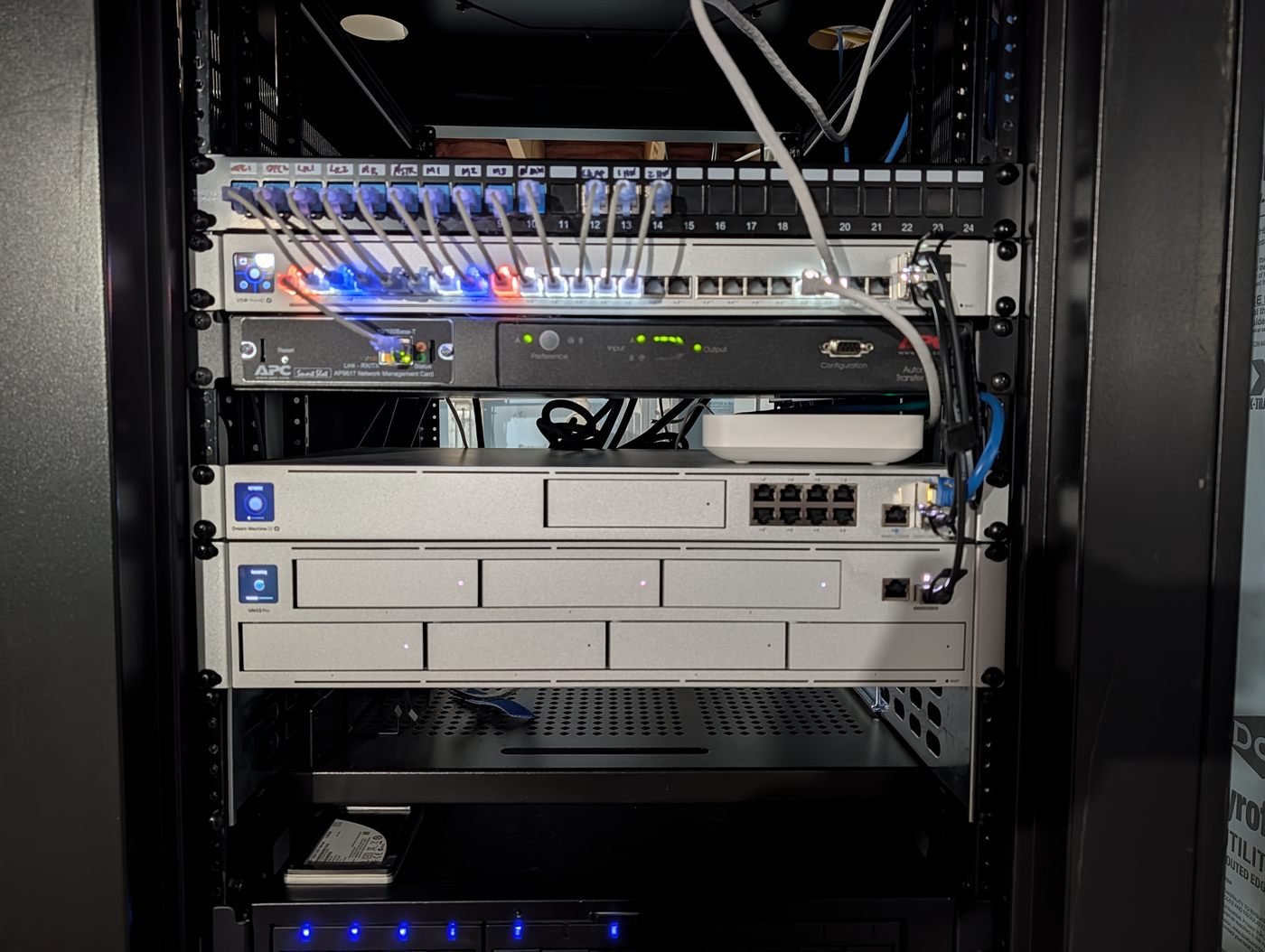
Routing, firewall, DHCP, DNS, and the controller all live in the same box now, under one interface, on a platform that gets updates I do not have to vet myself. There are 2Gbps of fiber coming into the house, and the ONT sits directly on top of it.
Switching came next. The Dell enterprise switch I had been running was capable and loud, and configured through a CLI I had to relearn every single time I touched it. The UniFi Pro HD 24 PoE that replaced it shows up in the same place as everything else, so ports and VLANs and PoE are right there when I need them. It feeds the patch panel at the top of the rack, which runs out to CAT6 I had pulled through the house while it was being built. Eight years on, that is still one of the few decisions I have never once regretted.
Below the switch is an APC automatic transfer switch, backed by two batteries at the bottom of the rack. Below that, most recently, a UNAS Pro. My backup server now runs two 10GbE links into the switch, one for client backups and one running straight to the NAS. That was a fun, long Saturday to get set up.
Wireless is a handful of UniFi access points spread through the house. That deployment is a story on its own, mostly because while running one of the drops I put a hole in a PEX water line. Another time (my ego is STILL a little bit bruised but that's ok, my wife has forgiven me).
Cameras are next. The doorbell first, and then I expect I will keep going.
None of this means I stopped building. Down at the bottom of that rack, mostly out of frame, is a machine I finished recently to run my AI memory system: built by hand, dual GPUs, ZFS mirrors, 4U chassis. It is exactly the kind of project I would have filmed fifteen years ago, and I still love that part of it. There are only so many hours in a week now, and I would rather spend them on the parts I actually find interesting. Designing a network that holds up without me is one of those. Rebuilding a router out of spare parts is not, at least not anymore.